





If you've ever walked into a perfumery or even just taken a quick glance at the skincare shelves, you've probably noticed that hyaluronic acid is everywhere. In serums, creams, masks, ampoules, cleansers. It has almost become a symbol of modern hydration — and in part, it truly is. But behind such a technical name lies a fascinating story and rather elegant chemistry.
In this article, we'll try to explain what hyaluronic acid really is, why serum is the best way to apply it, what the "molecular weights" that are increasingly talked about mean, and how to effectively incorporate this ingredient into your daily routine. Without overcomplicating things — but without oversimplifying them either.
First of all: what is hyaluronic acid and why is it so important for the skin?
Hyaluronic acid is not an artificial substance invented in a laboratory for the beauty market. It is a molecule that your body produces naturally — it is present in the skin, joints, synovial fluid, and the vitreous humor of the eye. It is wherever hydration and structure are needed.
Its most extraordinary characteristic is its ability to retain enormous amounts of water relative to its own weight: a single molecule of hyaluronic acid can bind up to a thousand times its weight in water. It is this unique property that makes it so valuable for skin care: when present in adequate quantities, it keeps skin tissues hydrated.
The problem is that the body's production of hyaluronic acid progressively decreases with age. After 25-30 years, levels begin to decline, and this gradually leads to skin that appears less toned, less radiant, and more prone to the formation of fine lines.
That's why applying it externally, through targeted cosmetic products, has become one of the most widespread skincare practices.
Why serum? The difference from creams and other formats
If hyaluronic acid is so useful, why isn't a normal moisturizer enough? The answer depends on the concentration and skin absorption capacity.
The hyaluronic acid serum, therefore, is designed to be the "treatment" phase of the routine: it is applied after cleansing and before cream, on clean and slightly damp skin (which further aids the absorption of hyaluronic acid), and works in synergy with the cream applied afterwards.
Serum vs. cream: what is the role of each?
A good routine doesn't involve choosing between serum and cream, but using both in sequence. Serum contains active ingredients in a higher concentration; cream seals in moisture and protects the skin barrier. They are two complementary, not alternative, phases.
Serum is a cosmetic format with very specific characteristics: it generally has a light and fluid texture, is formulated with a higher concentration of active ingredients than a standard cream, and contains fewer emollient or occlusive agents that could reduce absorption on the surface. In practice, serum is designed to facilitate the application of active ingredients to the skin.
The molecular weight of hyaluronic acid: the key that changes everything
Here we delve into the detail that truly distinguishes an effective serum from one that does little more than hydrate the surface. We'll do this with an analogy: think of hyaluronic acid molecules as balls of different sizes that need to pass through a net — the skin's structure.
Large balls remain on the surface. Small ones pass through.
Here's what "molecular weight" of hyaluronic acid means:
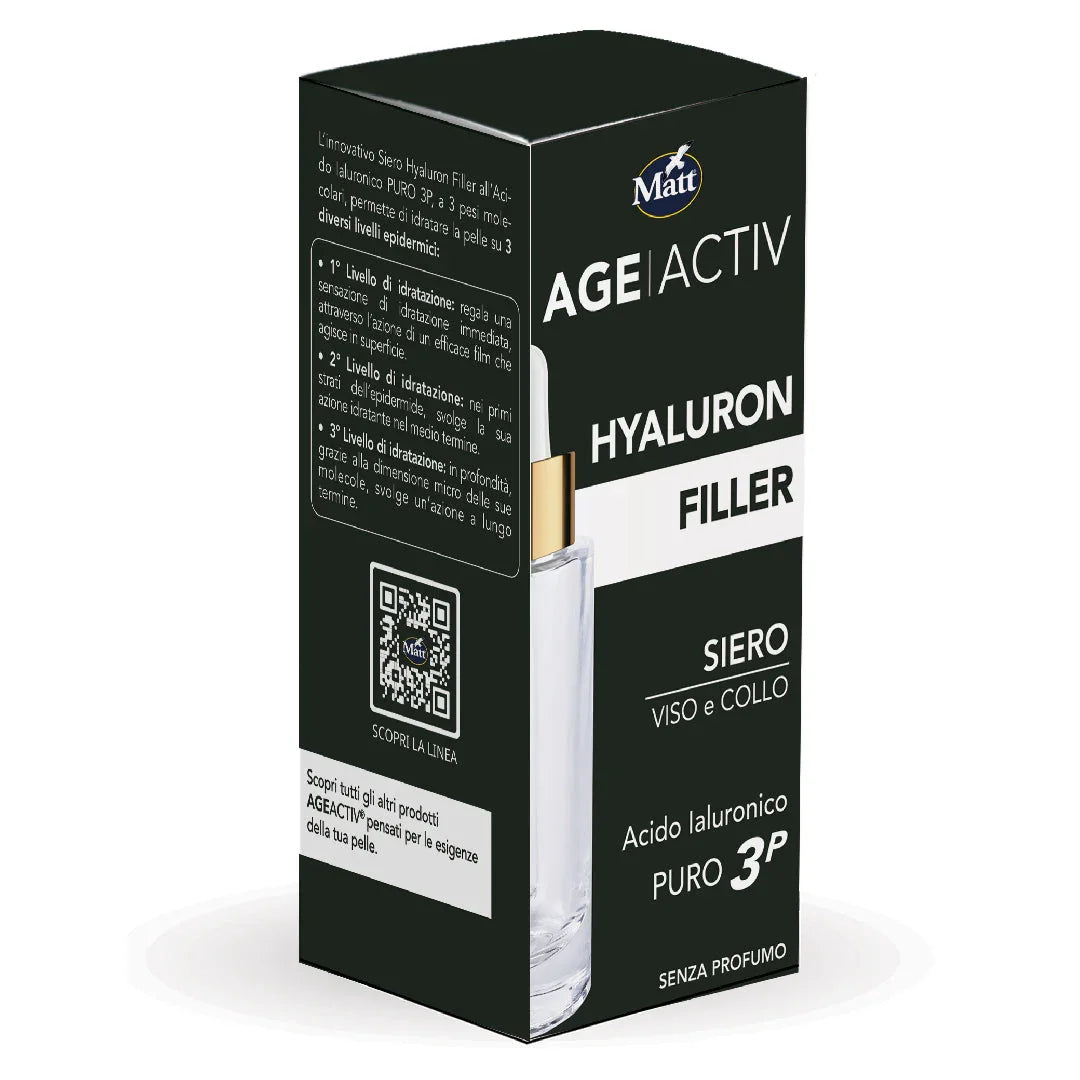
- High molecular weight (HMW): large molecules, remaining in the superficial layers of the epidermis. They form a moisturizing film on the skin surface that reduces transepidermal water loss, providing an immediate feeling of softness and hydration.
- Medium molecular weight (MMW): intermediate-sized molecules, penetrating the first layers of the epidermis for medium-term hydration.
- Low molecular weight (LMW): small molecules, capable of penetrating deeper into the epidermis for more lasting and structural hydrating action.
A serum that contains only high molecular weight hyaluronic acid hydrates the surface well, but does not act in the deeper layers. A serum with only small molecules penetrates deeply but may feel less immediate. The combination of multiple molecular weights offers a complete action: immediate hydration on the surface, and progressive action in the deeper layers of the skin tissue.
This is why in the most advanced formulations you will find indications like "3P" or "4P" (3 or 4 molecular weights): it is not marketing, it is a precise formulation choice.
How to use hyaluronic acid serum: common mistakes and practical tips
Hyaluronic acid is a powerful ingredient, but to work best, it needs certain conditions. Here are the points that truly make a difference.
Apply it to slightly damp skin
Hyaluronic acid is a humectant: it attracts and retains water. If you apply it to perfectly dry skin, it might draw water from the deeper layers of the skin to the surface. Applying it to freshly patted — still slightly damp — skin promotes absorption and helps maintain superficial hydration.
Always seal with a cream
As mentioned, serum works in depth but does not create a protective barrier. To maximize its effect, always apply a moisturizing or nourishing cream over the serum: this helps to retain water in the skin and reduce transepidermal water loss.
Use a few drops and distribute them evenly
Serums are formulated with a high concentration of active ingredient: there's no need to overdo it. A few drops (generally 3-5, or the amount indicated by the manufacturer) evenly distributed on the face and neck are sufficient for effective application.
Use it consistently
The results of a hyaluronic acid serum build up over time. Occasional application can provide a pleasant immediate moisturizing sensation, but it is daily use — morning and evening — that truly makes a difference to skin quality in the medium to long term.
It's not just for mature skin
A common mistake is to think of hyaluronic serum as an "anti-aging" product. Hyaluronic acid is useful for any skin type that needs hydration at any age. Prevention, in skincare, is always the best strategy.
What to look for (and what to avoid) when choosing a hyaluronic acid serum
The market is full of hyaluronic acid serums: how do you navigate it? Here are the parameters that really matter.
✔ What to look for
- Multi-molecular weight hyaluronic acid: as explained, the plurality of molecular sizes ensures action at multiple skin levels.
- Complementary ingredients: glycerin, panthenol, aloe vera, and other humectants work in synergy with hyaluronic acid to help keep the skin hydrated.
- Fragrance-free formula: fragrance in cosmetics is one of the main causes of skin irritation, especially for sensitive skin.
- Dermatological tests: this indicates that the product has been evaluated on skin for compatibility and tolerability.
- Italian or European production: guarantees compliance with stringent regulatory standards for cosmetic safety.
✘ What to avoid
- Products with single molecular weight hyaluronic acid marketed as "complete."
- Formulations with long INCI lists of irritating preservatives and alcohols.
- Serums with exaggerated and unverifiable claims.
The Hyaluron Filler AgeActiv Matt line: an example of a comprehensive approach to hydration
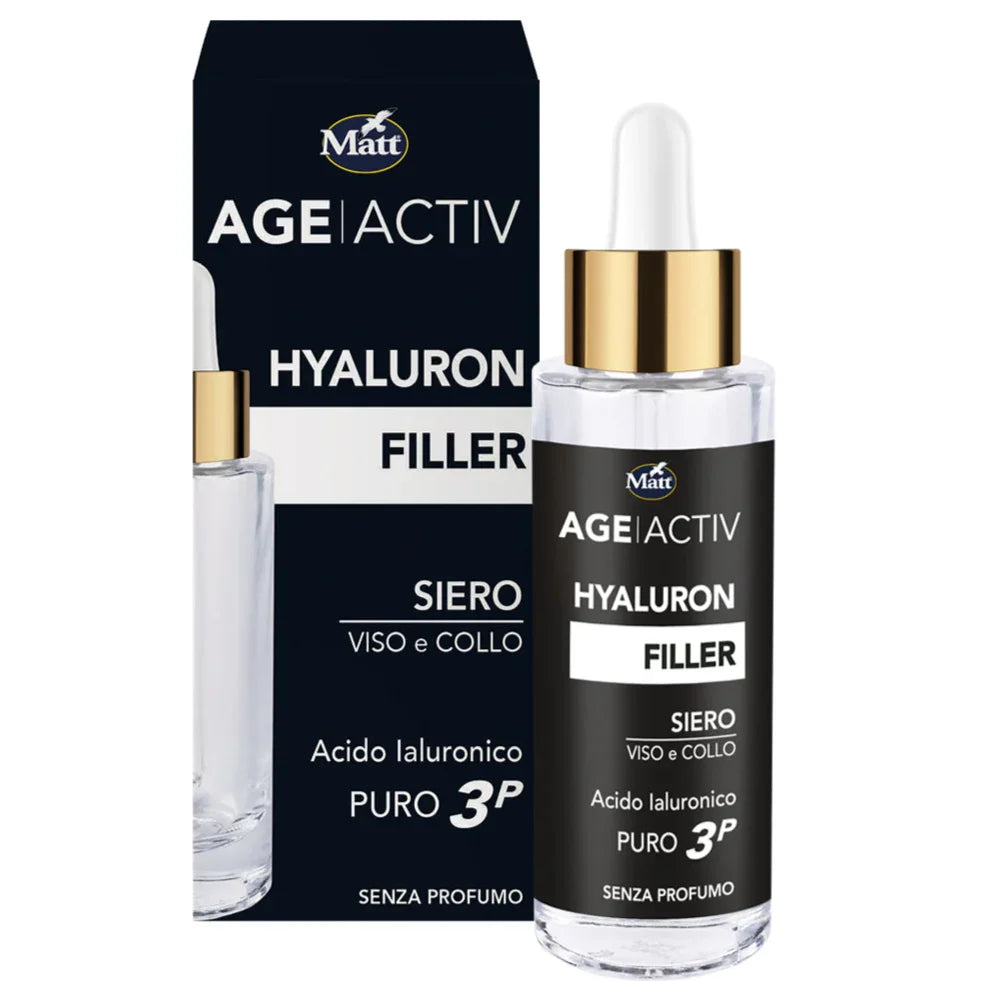
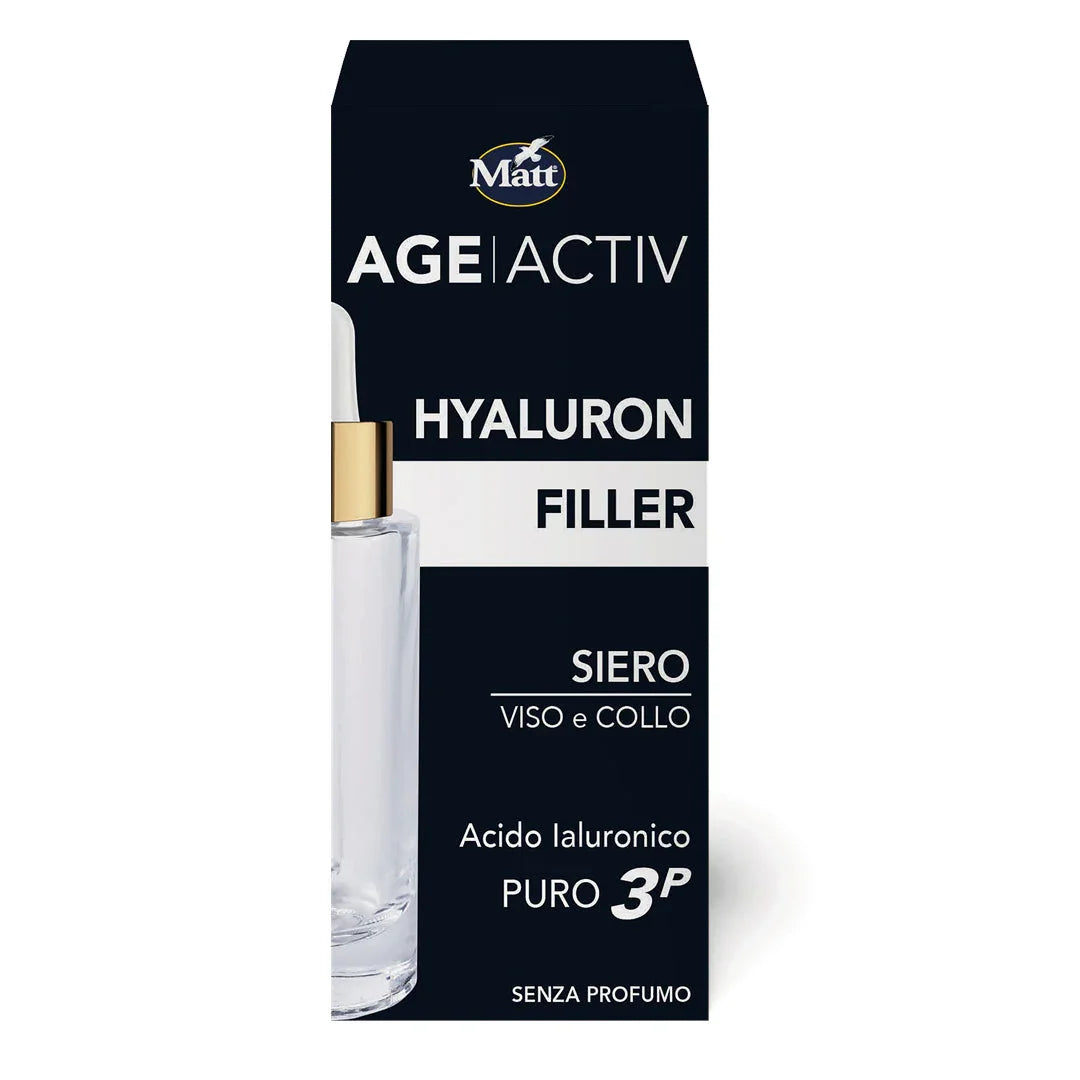
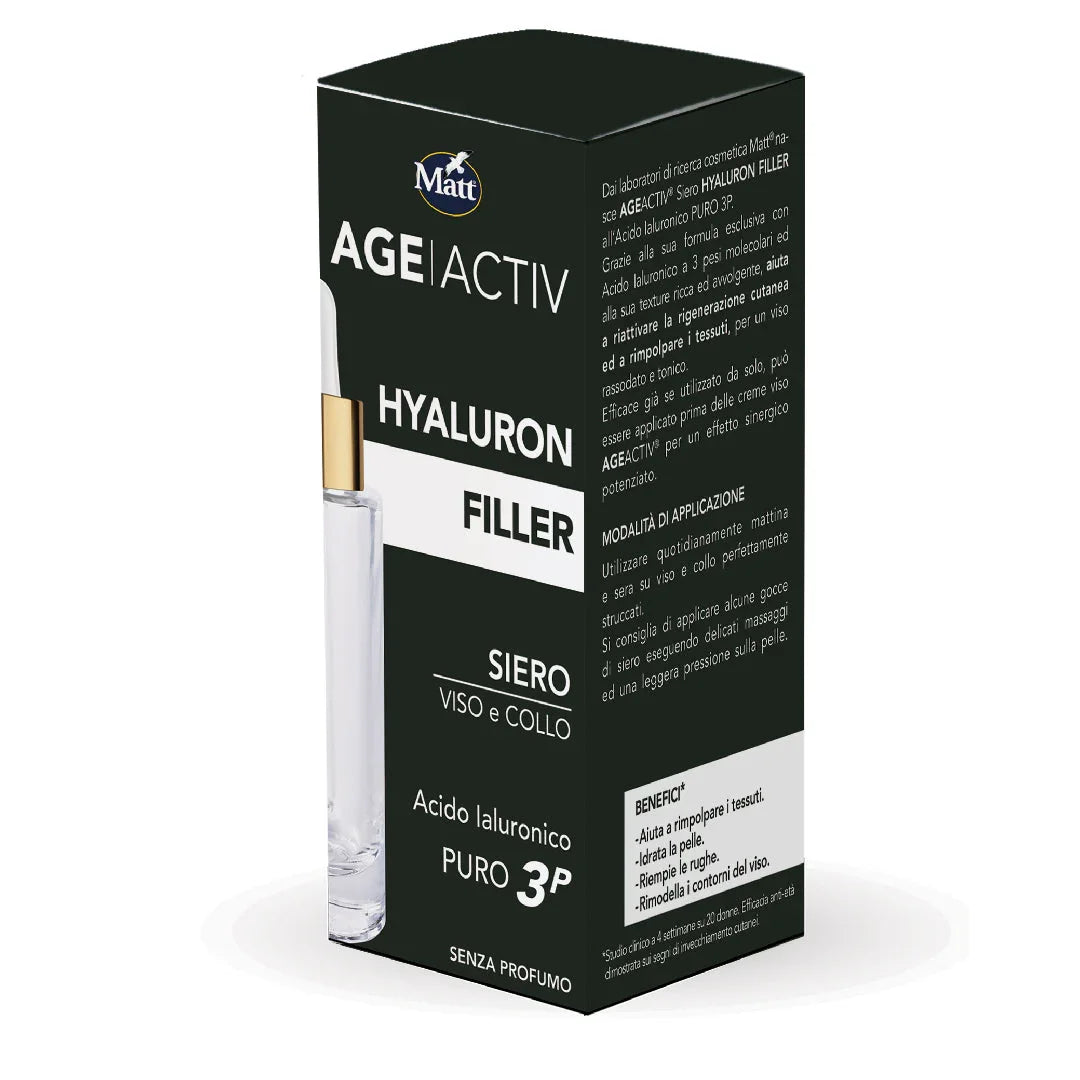
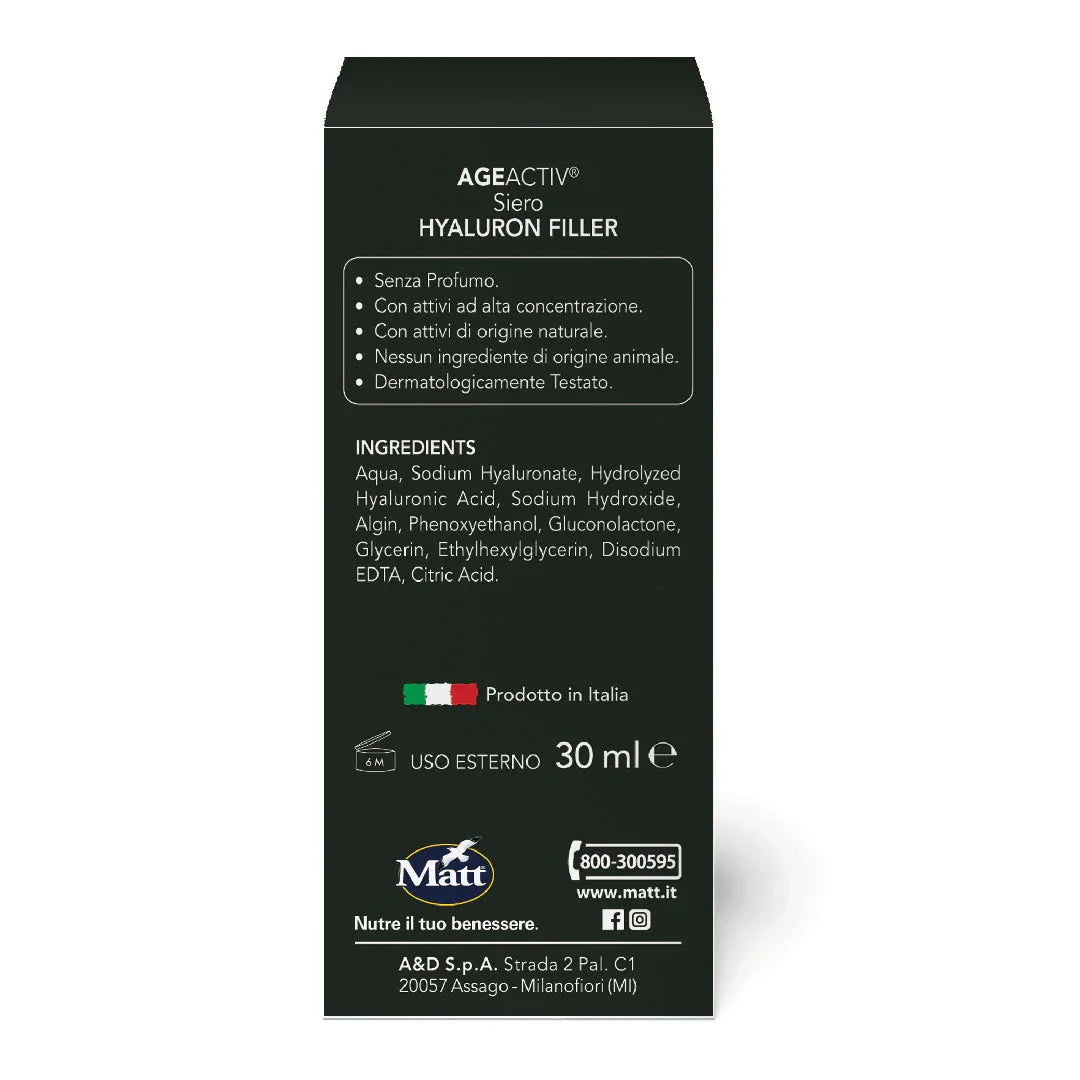
Speaking of hyaluronic acid serums formulated with attention to molecular weights, it is worth mentioning the AgeActiv Hyaluron Filler line by Matt — a cosmetic range built entirely around the concept of multi-level hydration, produced in Italy.
The central product of the line is the Hyaluron Filler AgeActiv Serum (30 ml): formulated with pure hyaluronic acid at 3 molecular weights (3P), it acts on three distinct skin levels. High molecular weight molecules provide immediate surface hydration; medium molecular weight ones act in the first layers of the epidermis; low molecular weight ones penetrate deeper for long-term action. The texture is rich but not heavy, absorbs quickly without leaving residue, and is formulated without fragrance — an important detail for those with sensitive or reactive skin.
Around the serum, the Hyaluron Filler line builds a true skincare ecosystem:
- The Hyaluron Filler Day Cream (50 ml) — with 3P hyaluronic acid and SPF 15 sunscreens (in vitro test; not a substitute for a sun product) — works to promote skin regeneration, making the skin appear smoother, more elastic, and hydrated.
- The Hyaluron Filler Night Cream (50 ml) works during nighttime hours, when the skin is most receptive and skin regeneration is naturally more active.
- The Hyaluron Filler Eye Contour (15 ml) is specifically formulated for the periorbital area, with 3P hyaluronic acid and an active draining complex that helps improve microcirculation, reducing puffiness and wrinkles.
- The Hyaluron Filler Mask — made of 100% natural and biodegradable fabric — is an intensive treatment for moments of hydrating boost, ideal after periods of stress or seasonal changes.
- The Hyaluron Filler Intensive Treatment is the most concentrated proposal: 7 single-dose ampoules with pure hyaluronic acid at 4 molecular weights (4P), to be used in weekly cycles on the face and neck. Its anti-aging efficacy is demonstrated by a 7-day clinical study.
- Finally, the Hyaluron Filler Cleansing Gel completes the routine from the first step: it deeply cleanses while respecting the hydrolipidic barrier and prepares the skin to best receive subsequent treatments, thanks to the presence of hyaluronic acid already in the cleansing phase.
What distinguishes this line is not simply the presence of hyaluronic acid — now common in many products — but the formulation consistency: each product uses pure hyaluronic acid with differentiated molecular weights, no animal-derived ingredients, no added fragrance, and all products are dermatologically tested. This is the approach of those who think of skincare as a system, not as a series of disconnected products.
You can explore the full range on the website in the plumping cosmetics section or in the AgeActiv anti-aging line.
Recommended routine with hyaluronic acid serum
For those who want a practical reference, here's how to integrate hyaluronic serum into an effective daily routine.
Morning
- Cleansing with a gentle cleansing gel or milk (also enriched with hyaluronic acid)
- Hyaluronic acid serum on still slightly damp skin — 3-4 drops, spread over face and neck with light patting
- Eye contour cream (if included in the routine)
- Day cream — preferably with SPF to protect against photoaging
Evening
- Double cleansing if wearing makeup (makeup remover + cleansing gel)
- Hyaluronic acid serum on damp skin. Intensive treatment (ampoules) in periodic cycles, instead of serum
- Night cream, richer and more nourishing than day cream
1-2 times a week: mask at the end of the evening cleansing routine, before night cream.
Does hyaluronic acid serum really work?
Yes, but with an important clarification: hyaluronic serum does not change the deep structure of the skin as a medical-aesthetic treatment would (injections, fillers). What it does - and does well, if used consistently - is deeply hydrate, improve skin texture, reduce the appearance of superficial wrinkles related to dehydration, and make the skin more luminous and toned.
Is hyaluronic acid serum suitable for all skin types?
Yes, it is one of the most universal cosmetic ingredients available. It is suitable for dry, combination, oily, sensitive, and mature skin. Oily skin types often avoid rich creams but can greatly benefit from a light hyaluronic serum followed by an oil-free moisturizer. Sensitive skin benefits from fragrance-free formulations. There are no general contraindications for topical use of hyaluronic acid.
How many times a day should hyaluronic serum be applied?
Most formulations recommend applying it twice a day, morning and evening. Some more concentrated versions (such as ampoule treatments) may be designed for evening use or for specific week-long cycles. Always follow the instructions for the specific product you are using.
What does "hyaluronic acid with 3 or 4 molecular weights" mean?
It means that the product contains hyaluronic acid in three or four different forms, characterized by different molecular sizes. The larger ones act on the surface, providing immediate hydration; the smaller ones penetrate deeper for a long-lasting action. A multi-molecular weight formula ensures hydration that acts on multiple skin layers simultaneously, resulting in a more complete effect compared to a product with only one type of hyaluronic acid.
Can hyaluronic serum be used with other serums or active ingredients?
Generally, yes, and hyaluronic acid is considered one of the most "compatible" active ingredients available. It pairs well with vitamin C (in the morning), retinol (in the evening), niacinamide, and AHAs. If you use multiple serums, the general rule is to apply them from the lightest to the densest texture, and to incorporate hyaluronic acid as a hydrating base on which to layer other active ingredients.